
Shopify
×

Papercrane
What did your Shopify store actually make last month?
Shopify alone can't answer that. Papercrane's AI agent joins your store with Stripe, Klaviyo, and your books, then builds a hosted dashboard your whole team can open.
Connect in about a minute. Free to connect and ask. Paid plans start when you publish a dashboard. See pricing
You have hit this wall before
The report that isn't there
Custom reports live on higher Shopify plans, and even there you build inside Shopify's fields. This morning's question doesn't fit them.
The spreadsheet ritual
Export orders, paste in processor fees and product costs, repair the formulas. Two hours later you have a number, and you'll do it again next month.
The analytics shelf
Profit tracking is one app, LTV another, custom reports a third. That line on your app bill runs $150 to $500 a month before you've asked a single new question.
Where “Total sales” goes
Shopify's headline number is sales, not what you made. The rest of the answer lives in four other systems, and Papercrane connects to all of them.
Net profit, July
For most stores this is the first dashboard Papercrane's agent builds, from your numbers, in one conversation.
Ask the questions you stopped asking
What did I actually make last month, after refunds, fees, and returns?
Which products get reordered most, and how long between orders?
Who are my top 50 customers by lifetime value, and what did they buy first?
Which discount codes bring in new customers, and which just cut margin on sales I would have made anyway?
Will anything stock out in the next 30 days at current velocity?
Did the last email campaign move revenue, or just clicks?
Every answer comes back as a chart on a live dashboard, not a paragraph you have to trust.
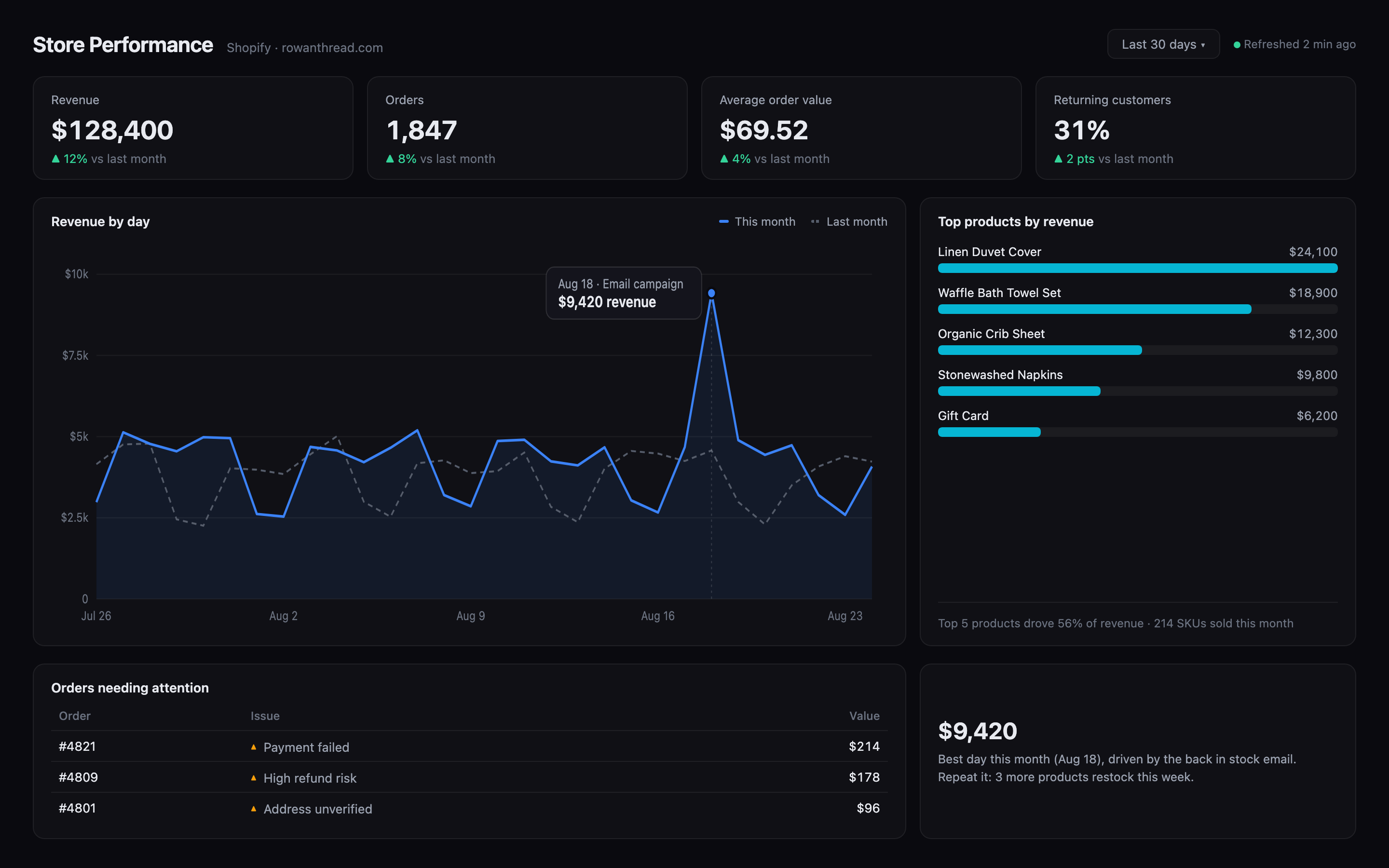
Built by Papercrane's agent from one conversation. Refreshes on its own.
1. Connect your store
2. Ask a question
3. The agent plans, queries, and builds a hosted dashboard
4. It stays live, and errors route back to the agent
Read access to the store data you already have. Nothing to install in your theme.
Three ways to get an answer out of your store
| The job | Shopify admin | Exports and spreadsheets | Shopify + Papercrane |
|---|---|---|---|
| Answer a question the standard reports don't cover | Custom reports on higher plans, within Shopify's fields | CSV export, then an evening of pivot tables | Ask it, get a chart in minutes |
| See profit, not just sales | Sales and discounts only; fees and costs live elsewhere | Paste in Stripe fees and COGS by hand, every month | Joins Stripe, PayPal, and QuickBooks automatically |
| Share with your team or accountant | Add them as staff, walk them to the report | Email the file, now there are five versions | Send a link to a live dashboard |
| Keep it current | Current, inside the admin | Stale the moment you export | Refreshes on schedule, stays hosted |
| When a number looks wrong | Rebuild the report yourself | Find the broken formula | Errors route back to the agent, which fixes the dashboard |
The monthly close
A home goods merchant closes her month with one question: store revenue minus refunds, processor fees, and cost of goods from QuickBooks. The answer is a dashboard her accountant now checks instead of emailing her.
The restock call
Sales velocity per SKU against inventory on hand, with a flag when cover drops under 30 days. The reorder happens two weeks earlier than it used to.
The discount audit
Codes ranked by how many genuinely new customers they brought in versus margin given away on repeat buyers. Two codes got retired the same afternoon.
When you don't need us
If the sales overview in Shopify admin answers your questions, keep your money; it's good, it keeps improving, and Sidekick is free. If your whole job is paid ads attribution, a pixel product like Triple Whale is built for that and we are not. Papercrane is worth paying for when the answer spans more than one system, or when the result needs to live somewhere your team, your clients, or your accountant can watch it.
Questions merchants ask us
Shopify answers get better with company. Most stores connect Stripe for fees, Klaviyo for campaigns, and QuickBooks for the close.
Connect your store, ask what you made last month, and watch the answer come back as a dashboard.
Connect in about a minute. Free to connect and ask. Paid plans start when you publish a dashboard. See pricing